
The move from toddlerhood to preschool is a gradual shift in how children communicate, play, manage daily routines, and learn—not a sudden developmental cutoff. The Centers for Disease Control and Prevention (CDC) organizes its milestone guidance around ages 2, 3, 4, and 5, offering families practical examples of skills to watch for while emphasizing that milestones are not substitutes for developmental screening. Understanding this transition helps caregivers support growing independence, recognize individual variation, and seek timely advice when concerns arise.
Preschool transition and developmental change
The toddler-to-preschool transition describes the period when a young child increasingly uses language, imagination, social interaction, and self-help skills to take part in family and group routines. There is no single universal age at which a child “becomes” a preschooler: families and early-learning programs commonly use preschool for children around ages 3 to 5, while development proceeds at different rates.
The American Academy of Pediatrics (AAP) describes early childhood as a period of rapid growth shaped by relationships, health, and experience. In practical terms, the transition includes several connected changes: expanding communication, more complex play, emerging emotional regulation, growing physical coordination, and increasing participation in everyday tasks. These skills overlap; a child may be advanced in one area and still need support in another.
Age ranges and milestones
Developmental milestones are behaviors that most children—at least 75 percent, according to the CDC’s milestone framework—can do by a particular age. They are useful checkpoints, not a scorecard or a promise that every child will reach each skill on the same date.
For example, CDC guidance for age 3 includes joining other children in play and having at least two back-and-forth exchanges in conversation. By age 4, examples include pretending to be someone or something else during play and describing at least one thing that happened during the day. At age 5, examples include telling a story with at least two events and following rules or taking turns in games. These examples illustrate a broad progression from shared activity toward more sustained communication and cooperative play.
Why the transition matters
Skills that emerge during this period help children participate in preschool routines, build relationships, and express needs. They also help adults identify where a child may benefit from additional practice or evaluation. The CDC recommends developmental monitoring and states that standardized developmental screening should be carried out at specified ages and whenever a parent or provider has a concern. A milestone checklist can support a conversation, but it cannot diagnose a developmental condition.
Communication and language development
Communication development is the growing ability to understand language, express ideas, take conversational turns, and use communication for social purposes. It includes spoken words, gestures, facial expressions, listening, and—when appropriate—alternative communication methods. Language growth varies, and the quality of a child’s communication matters alongside the number of words they use.
The National Institute on Deafness and Other Communication Disorders (NIDCD) explains that speech and language develop through interaction and that hearing plays an important role in learning spoken language. In everyday life, caregivers can encourage communication by following a child’s attention, responding to attempts to communicate, and making room for back-and-forth exchanges rather than relying only on questions or instructions.
Conversation and expressive language
Expressive language is how children share thoughts, needs, and experiences through words, signs, gestures, or other communication. Across the preschool years, children typically move from short exchanges toward longer descriptions and stories. CDC milestones offer examples of this development, including conversational turn-taking at age 3 and telling a story with at least two events by age 5.
Caregivers can support this growth by narrating shared activities, reading together, singing, and expanding on a child’s words. If a child says “big truck,” an adult might respond, “Yes, the big red truck is carrying blocks.” The goal is responsive interaction, not drilling a child to perform on demand. Children who use more than one language may distribute their words across languages; families should share the languages used at home with educators and clinicians when discussing development.
Understanding and following directions
Receptive language is the ability to understand words, questions, and directions. It develops alongside expressive language, though a child may understand more than they can say. Short, clear directions paired with gestures or visual cues can make routines easier to follow, especially when a child is tired, excited, or adjusting to a new setting.
If a child often seems not to hear, has difficulty understanding familiar directions, or loses communication skills they previously used, caregivers should discuss the observation with the child’s health care provider. Hearing, language, and broader developmental factors can all affect communication, so an evaluation can help identify what support is appropriate.
Social-emotional growth and play
Social-emotional development includes recognizing and expressing feelings, building relationships, coping with frustration, and learning to participate with others. Play is one of the main ways young children practice these skills. The AAP’s guidance on early childhood emphasizes nurturing relationships and play as important contexts for learning and development.
The progression is not a simple change from solitary play to constant cooperation. Children may play alongside others, briefly join a shared activity, then return to playing independently. Interest in peers can grow even while turn-taking and conflict resolution remain difficult.
Pretend play and imagination
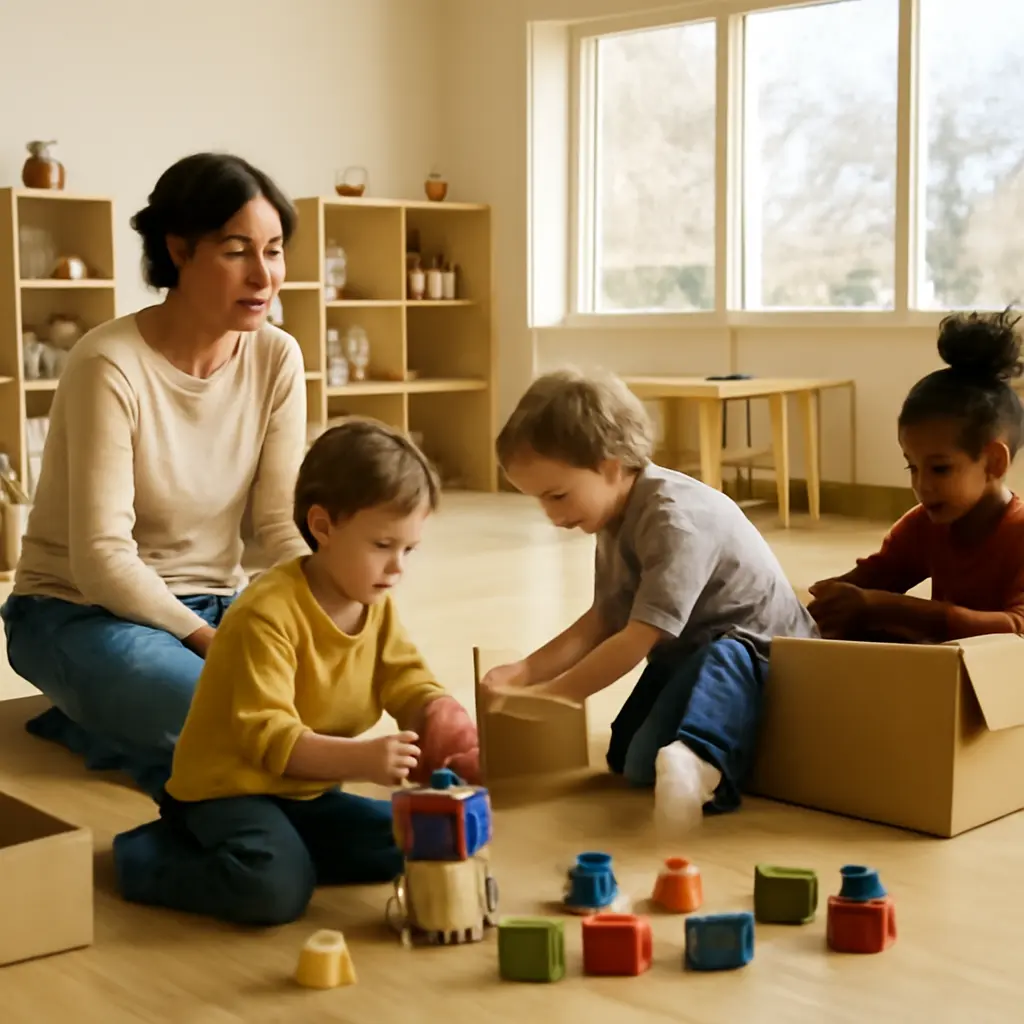
Pretend play is the use of imagination to represent people, objects, or events—for example, treating a block as a phone or acting out a familiar household routine. CDC age-4 milestones include pretending to be someone or something else during play. This kind of play can give children opportunities to practice language, flexible thinking, and perspective-taking.
Adults can encourage pretend play with simple, open-ended materials such as boxes, dolls, toy animals, or kitchen items. Joining a child’s play is often most useful when the adult follows the child’s lead, adds language, and avoids turning play into a test with a “right” answer.
Emotional regulation and peer relationships
Emotional regulation is the developing ability to notice feelings and manage reactions with support. Preschoolers are still learning to wait, share, recover from disappointment, and use words instead of actions. Calm adult modeling, predictable routines, and simple emotion labels—such as “You look frustrated”—can help children connect feelings with coping strategies.
Peer relationships provide practice in cooperation, but conflict is a normal part of learning. Adults can coach children through brief, concrete steps: name what happened, acknowledge each child’s perspective, and help them choose a next step. CDC milestones such as joining other children in play at age 3 and taking turns in games by age 5 are broad examples, not requirements for every play session.
Physical development and everyday independence
Physical development includes gross-motor skills, such as running and climbing, and fine-motor skills, such as drawing, handling small objects, and using utensils. Growing coordination supports participation in play and daily routines. Independence also develops through repeated opportunities to try tasks, with adults providing the amount of help a child needs.
The World Health Organization’s guidelines for children under 5 connect healthy development with physical activity, sleep, and limits on sedentary screen time. Its recommendations vary by age: for children ages 3 to 4, WHO advises at least 180 minutes of physical activity across the day, including at least 60 minutes of moderate-to-vigorous activity. These are population-level guidelines; families should consider a child’s health and seek individualized advice when needed.
Gross- and fine-motor skills
Gross-motor skills use large muscles for movement and balance; fine-motor skills involve smaller movements of the hands and fingers. Active outdoor play, dancing, playground time, drawing, and building with age-appropriate blocks offer varied ways to practice. The aim is regular, enjoyable movement and exploration, not comparison with other children.
For ages 3 to 4, WHO recommends limiting sedentary screen time to no more than one hour per day, with less being better, and ensuring adequate sleep within a 24-hour day. Its guidance for this age group recommends 10 to 13 hours of sleep, which may include naps. These recommendations can help families plan balanced routines that leave room for movement, sleep, and face-to-face interaction.
Self-help routines and toileting
Self-help skills include participating in dressing, washing hands, eating, tidying, and toileting. They develop through practice and are influenced by a child’s physical readiness, communication, temperament, and environment. A child may complete one step independently while needing help with another.
The American Academy of Pediatrics advises families to look for readiness signs rather than rely on a fixed age for toilet learning. Caregivers can make routines predictable, use simple language, and respond without shame or punishment to accidents. If toileting is painful, unusually stressful, or accompanied by health concerns such as constipation, consult a health care professional.
Preschool readiness, support, and screening
Preschool readiness is a combination of developing skills and supportive circumstances, not a single test or checklist. Children enter group settings with different experiences, strengths, communication styles, and support needs. Readiness is best considered across several areas: participating in routines, communicating needs, engaging with adults and peers, and managing transitions with appropriate help.
The National Association for the Education of Young Children (NAEYC) describes developmentally appropriate practice as teaching that takes account of children’s common developmental patterns, individual differences, and social and cultural contexts. This perspective supports flexible expectations: a child may need visual schedules, extra transition time, language support, or assistance with sensory and emotional needs.
Preparing for a preschool setting
Preparation can focus on familiarizing a child with the setting and routines rather than rehearsing academic performance. Families may visit the classroom, practice a goodbye routine, label belongings, and share useful information with educators about the child’s interests, communication, health, and comfort strategies.
A real-world example is a child who finds cleanup difficult but responds well to a visual cue and a two-minute warning. A family and teacher can use the same simple signal at home and school, then gradually encourage the child to take part in putting materials away. This coordinated approach builds participation without treating difficulty with transitions as misbehavior.
Developmental monitoring and when to seek help
Developmental monitoring is the ongoing process of observing a child’s skills and discussing progress with caregivers and professionals. Screening uses a validated tool to check whether a child may need further evaluation. The CDC advises families to act early if a child is not meeting one or more milestones, loses skills, or a caregiver has concerns, and to raise those concerns with the child’s doctor.
The U.S. Preventive Services Task Force has noted that evidence is insufficient to determine the balance of benefits and harms of universal screening for speech and language delay in children without signs or concerns. This does not mean concerns should be ignored: families can request an evaluation when they notice a difficulty, and clinicians can consider the child’s history and symptoms. Depending on the concern, next steps may include hearing assessment, speech-language evaluation, or referral to early intervention or school-based services.
Conclusion: supporting the toddler-to-preschool transition
The toddler-to-preschool transition brings changes in communication, social-emotional development, play, physical coordination, and everyday independence. CDC milestones offer useful age-based examples, while WHO guidance highlights the role of movement, sleep, and balanced routines. Neither replaces attention to each child’s circumstances or professional screening when concerns arise.
Caregivers can support the transition through responsive conversation, child-led play, predictable routines, and opportunities to practice self-help skills. Keep notes about questions or changes in development and discuss them with a health care provider or early-learning professional. For further guidance, consult CDC milestone resources, your pediatric clinician, and local early-intervention or preschool services.
Sources: Centers for Disease Control and Prevention, Developmental Milestones, https://www.cdc.gov/ncbddd/actearly/milestones/; American Academy of Pediatrics, HealthyChildren.org, Developmental Milestones: 3 to 4 Year Olds, https://www.healthychildren.org/English/ages-stages/preschool/Pages/Developmental-Milestones-3-to-4-Year-Olds.aspx; National Institute on Deafness and Other Communication Disorders, Speech and Language Developmental Milestones, https://www.nidcd.nih.gov/health/speech-and-language; World Health Organization, Guidelines on Physical Activity, Sedentary Behaviour and Sleep for Children Under 5 Years of Age, https://www.who.int/publications/i/item/9789241550536; American Academy of Pediatrics, Toilet Training: Common Questions and Answers, https://www.healthychildren.org/English/ages-stages/toddler/toilet-training/Pages/default.aspx; National Association for the Education of Young Children, Developmentally Appropriate Practice, https://www.naeyc.org/resources/position-statements/dap; U.S. Preventive Services Task Force, Speech and Language Delay and Disorders in Children: Screening, https://www.uspreventiveservicestaskforce.org/uspstf/recommendation/speech-and-language-delay-and-disorders-in-children-screening.
Related Posts
The hidden benefits of unstructured playtime for brain development
Unstructured play is child-led activity with no fixed script, prescribed…

The Hidden Truths Behind Child Care Basics Most Parents Learn Too Late
Fundamental Awareness in Child Care Basics Child care basics refer…