
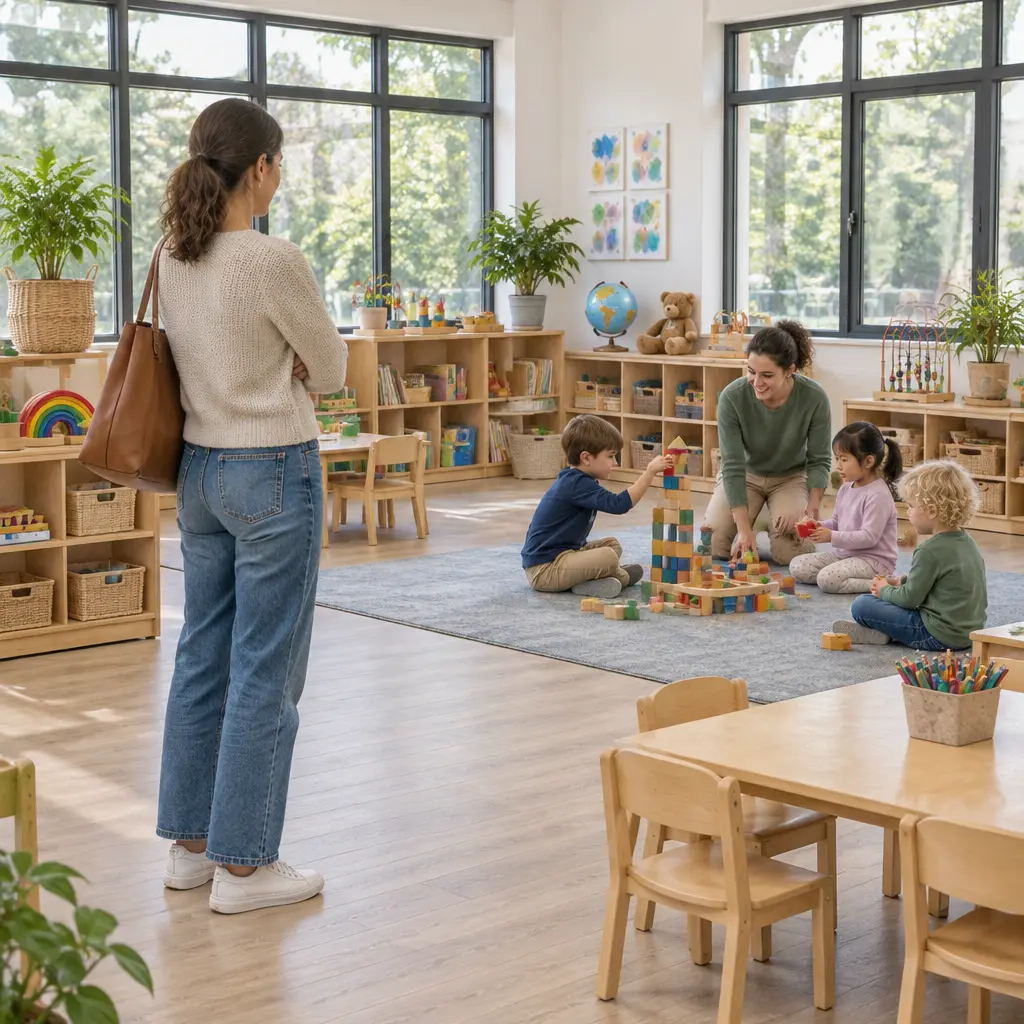
Choosing child care can feel like comparing brightly colored rooms, elaborate play structures, and long lists of toys. But child care quality is better judged by what children experience every day: warm, responsive relationships; safe and dependable care; and engaging interactions that support learning. The National Institute of Child Health and Human Development’s Study of Early Child Care and Youth Development found that children in higher-quality care tended to have better language and cognitive outcomes, while the Centers for Disease Control and Prevention (CDC) emphasizes that nurturing relationships and safe environments support children’s healthy development. Families can look beyond appearances by observing caregiver-child interactions, checking supervision and routines, and asking how the program supports each child.
Responsive relationships are a central sign of child care quality
Responsive caregiving means adults notice children’s cues and respond warmly, promptly, and appropriately. The National Association for the Education of Young Children (NAEYC) describes developmentally appropriate practice as strengths-based, play-based, and attuned to each child’s individual development and context. In an early childhood setting, that principle shows up in everyday moments: a caregiver comforts a distressed toddler, listens to a preschooler’s question, or adjusts an activity when a child needs more support.
Quality is not simply a matter of whether a center owns attractive equipment. Research from the NICHD study associated higher-quality care with better language and cognitive development, while also finding that family characteristics and children’s experiences across settings matter. Observing interactions over time can therefore tell families more than a quick glance at a room’s décor.
Warm, attentive caregiver-child interactions
A warm interaction is one in which a caregiver speaks respectfully, gets down to a child’s level, notices emotional signals, and offers comfort without shaming or dismissing the child. Look for adults who respond to children’s attempts to communicate, encourage them to try tasks, and guide behavior with calm, clear limits. These practices help children feel secure enough to explore and participate.
The CDC’s guidance on positive parenting highlights the value of noticing and responding to children’s needs and behavior. In a child care program, families can observe whether staff use children’s names, offer specific encouragement, and help resolve disagreements rather than relying mainly on criticism or commands.
Stable relationships and familiar caregivers
Continuity of care means children have consistent adults and predictable relationships, rather than frequently changing caregivers. Familiar adults can learn a child’s communication style, routines, comfort strategies, and emerging abilities. Ask how the program handles staff turnover, substitutes, room transitions, and communication when a child moves to a new classroom.
A stable caregiver does not guarantee quality on its own, but continuity makes responsive care easier to provide. Families should also find out whether children have a designated primary caregiver and how the program helps new children settle in.
Respectful guidance and emotional support
Positive guidance teaches children what to do instead of relying on fear, humiliation, or harsh punishment. A caregiver might help a child name a feeling, offer a safe alternative, or guide two children through taking turns. Ask staff to explain their approach to biting, hitting, tantrums, and other common developmental challenges.
A strong program can describe how it responds consistently while taking a child’s age, temperament, and developmental needs into account. Families should be cautious if staff describe routine yelling, threats, physical punishment, or isolation as normal discipline.
Safe supervision and dependable health practices define everyday care quality
Safety in child care is the active practice of preventing foreseeable harm through attentive supervision, appropriate staffing, clean and maintained spaces, and reliable health routines. It cannot be assessed by appearance alone: a polished room may still have unsafe supervision, while a modest space can be thoughtfully organized and well managed. Families should review a program’s license and inspection history with the relevant state, territorial, or local child care regulator.
The CDC’s child care health guidance treats hand hygiene, cleaning, vaccination policies, illness response, and communication with families as important parts of reducing the spread of disease. Safe care also depends on staff knowing children’s whereabouts and responding quickly to changing situations.
Active supervision and appropriate group size
Active supervision means caregivers position themselves to see and hear children, scan the space, anticipate risks, and stay close enough to intervene. Ask how staff supervise outdoor play, bathroom trips, meals, naps, and transitions between rooms. A center’s stated staff-to-child ratio is useful, but families should also ask whether it is maintained throughout the day, including during breaks and staff absences.
Ratios and group-size rules differ by jurisdiction and by children’s ages, so there is no single number that applies everywhere. Compare the program’s practices with the rules set by its licensing authority, and observe whether caregivers can respond to individual children without losing track of the group.
Cleanliness, illness policies, and emergency readiness
Health practices include regular handwashing, safe food handling, clean diapering areas, appropriate toy cleaning, and a clear plan for children who become ill. Ask how staff communicate about contagious illnesses, administer medication, store emergency contacts, and respond to injuries or severe allergic reactions. A well-run program can explain its procedures and show families where policies are documented.
The American Academy of Pediatrics’ HealthyChildren guidance encourages families to ask about health and safety policies when evaluating child care. During a visit, note whether sinks and changing areas appear clean, cleaning supplies are inaccessible to children, and staff follow the same hygiene routines they describe.
Safe, accessible spaces—not expensive equipment
A safe environment is arranged so children can move, explore, and play without avoidable hazards. Check that furniture is stable, outdoor areas are secure, age-appropriate materials are within reach, and damaged equipment is removed from use. Accessibility matters too: children with disabilities should be able to participate meaningfully, with reasonable adaptations to activities and spaces.
A large playground or a room full of new toys is not proof of close supervision or thoughtful planning. Look instead for how staff use the available space, whether children can reach materials safely, and whether the environment supports both active play and quieter activities.
Engaging interactions and purposeful play support learning
Developmentally appropriate learning is active, meaningful, and matched to children’s ages, abilities, interests, and backgrounds. It is not synonymous with expensive toys, worksheets, or a rigid academic schedule. NAEYC’s guidance emphasizes that play can support learning when educators intentionally build on children’s ideas, ask questions, and provide experiences suited to their development.
The U.S. Department of Health and Human Services’ Head Start Early Learning Outcomes Framework describes learning across areas including approaches to learning, language and literacy, cognition, and social-emotional development. Families can use those broad areas as a guide when asking how a program supports children’s growth through everyday activities.
Conversation that builds language and thinking
High-quality conversation is more than giving directions. Caregivers listen, respond to children’s ideas, introduce useful words, and ask questions that invite explanation. During a visit, notice whether adults talk with children during play and routines, or mostly speak to them to manage behavior and move the schedule along.
Shared reading, storytelling, songs, and conversations about daily experiences can all support language development. A varied bookshelf can be helpful, but the important quality sign is whether adults use books and conversation to connect with children rather than treating them as display items.
Play that offers choice, exploration, and challenge
Purposeful play gives children chances to make choices, investigate materials, practice skills, and learn alongside others. A block area, for example, can prompt problem-solving and collaboration when caregivers notice children’s plans and extend their thinking. Outdoor play can offer movement, observation, and imaginative exploration without requiring elaborate equipment.
Look for a balanced day that includes active and quiet experiences, child-led play, and adult-guided activities. The quality lies in how materials and interactions are used—not in how costly or fashionable the toys are.
Individualized care and inclusion
Individualized care recognizes that children develop at different rates and may need different forms of support. Ask how staff learn about a child’s interests, home language, routines, food needs, disability-related supports, and cultural background. Strong programs work with families to make participation possible and to respond to changes in a child’s needs.
A program’s approach is visible in ordinary decisions: whether books and play materials reflect varied families, whether staff pronounce children’s names correctly, and whether activities can be adapted so every child can take part. Inclusion should be explained through concrete practices, not just a statement of principle.
Family communication and program accountability complete the quality picture
Quality care depends on a working partnership between families and educators. Clear communication helps caregivers understand a child’s routines and helps families know what happened during the day. Accountability means the program can explain its policies, respond to concerns, and show how it meets applicable licensing and quality standards.
The U.S. Department of Health and Human Services’ Child Care and Development Fund supports child care assistance and state systems that help families access care and monitor providers. Because licensing and quality-rating systems vary, families should confirm details with their local child care agency rather than assuming that one label or rating means the same thing everywhere.
Two-way communication with families
Two-way communication means staff share useful updates and welcome information from families. Ask how the program reports meals, sleep, mood, activities, injuries, and developmental concerns. Families should be able to raise questions without being treated as a nuisance, and staff should explain who to contact when an issue needs follow-up.
A useful example is a caregiver who tells a parent not only that a child had a difficult transition, but also what seemed to help and what the team will try next. That kind of specific communication turns daily updates into a practical partnership.
Licensing, inspections, and quality improvement
Licensing establishes minimum legal requirements; it does not necessarily measure every feature of high-quality care. Families can look up inspection findings, ask how any cited problems were corrected, and check whether a provider participates in a local quality-improvement or rating system. A program that discusses improvement openly may be more informative than one that relies only on marketing claims.
Ask for written policies on discipline, supervision, illness, emergencies, fees, and staff qualifications. Then compare the answers with what you observe. If a program’s explanations and daily practices do not match, seek clarification before enrolling.
A practical checklist for evaluating child care quality
A visit is most useful when families watch real routines and ask specific questions. Consider arranging a tour during a typical part of the day, and, where permitted, observe more than one room or routine. Use the following checklist to focus on evidence rather than presentation:
- Do caregivers notice children’s cues and respond calmly and respectfully?
- Are children supervised during play, meals, naps, bathroom trips, and transitions?
- Can staff explain how they handle conflict, illness, medication, and emergencies?
- Do children have opportunities for conversation, choice, exploration, and rest?
- Are activities adapted to different ages, abilities, languages, and interests?
- Does the program communicate openly with families and provide written policies?
- Can you review current licensing information and inspection history through the relevant authority?
If possible, visit more than once and compare what you see with what staff describe. A calm, respectful exchange with caregivers—and a willingness to answer questions clearly—can offer a useful real-world sign of how the program treats families.
Conclusion: Relationships, safety, and purposeful play matter most
The strongest signs of child care quality are not fancy facilities or an impressive inventory of toys. They are responsive relationships, active supervision, consistent health and safety practices, engaging play and conversation, inclusive individualized care, and honest communication with families. Research and guidance from the NICHD, NAEYC, the CDC, and child health authorities all point families toward the importance of children’s daily experiences and interactions.
When choosing care, observe, ask specific questions, and verify licensing and inspection information with your local regulator. Families can also consult their state or local child care resource and referral agency for help comparing options. Looking closely at the people, routines, and relationships behind a program’s appearance is a practical step toward finding care where children can feel safe, connected, and ready to learn.
Sources: National Institute of Child Health and Human Development, Study of Early Child Care and Youth Development, https://www.nichd.nih.gov/research/supported/seccyd; National Association for the Education of Young Children, Developmentally Appropriate Practice, https://www.naeyc.org/resources/position-statements/dap; Centers for Disease Control and Prevention, Child Care and Schools, https://www.cdc.gov/children-and-school-preparedness/child-care/index.html; American Academy of Pediatrics, Choosing a Child Care Center, https://www.healthychildren.org/English/family-life/work-play/Pages/Choosing-a-Child-Care-Center.aspx; U.S. Department of Health and Human Services, Head Start Early Learning Outcomes Framework, https://headstart.gov/school-readiness/article/head-start-early-learning-outcomes-framework; U.S. Department of Health and Human Services, Child Care and Development Fund, https://www.acf.hhs.gov/occ/programs/ccdf
Related Posts

Child Care Workforce for Beginners A Simple Guide to Roles and Responsibilities
Child Care Workforce Composition and Responsibilities The child care workforce…

A Parent Story Dealing with Late Fees and Extra Charges in Child Care
Child Care Late Fees: Definitions and Implications Late fees in…
Choosing Child Care Visits That Reveal More Than a Polished Tour
Choosing child care visits that reveal more than a polished…