
Play-based early learning is the development of young children’s knowledge, skills, and dispositions through active, meaningful play. In child care, it does not mean leaving learning to chance: educators intentionally prepare materials, interact with children, and build on their interests. This approach supports language, early math, movement, self-regulation, and relationships while treating worksheets as an occasional tool rather than the center of learning. The National Association for the Education of Young Children (NAEYC) describes developmentally appropriate practice as strengths-based, play-based, and responsive to each child; research reviews also find that guided play can support learning in areas such as early math and shape knowledge.
Play-Based Learning Builds Early Learning and Child Development
Play-based learning combines children’s active exploration with adult support and clear developmental goals. The NAEYC’s guidance on developmentally appropriate practice emphasizes that educators make decisions using knowledge of child development, individual children, and their social and cultural contexts. In practice, an educator may notice children building a tall tower, introduce words such as “balance” and “higher,” and ask what might make the structure steadier. The children remain active problem-solvers while the adult extends the learning.
This matters because development is interconnected. A pretend grocery store can invite children to speak and listen, count objects, negotiate roles, and practice managing frustration. The Centers for Disease Control and Prevention (CDC) tracks developmental milestones across communication, movement, thinking, and social-emotional development. Milestones are useful prompts for observation, not a substitute for individualized assessment or a reason to compare children rigidly.
Free play: child-led exploration
Free play is activity children choose and direct, within safe and appropriate boundaries. Blocks, dolls, art materials, sensory tables, and outdoor spaces let children follow their curiosity, repeat actions, test ideas, and make decisions. An educator supports free play by arranging accessible materials, observing carefully, and stepping in when needed for safety, inclusion, or a helpful prompt—without taking over the play.
Guided play: child agency with educator support
Guided play keeps children actively involved while an adult shapes the environment or offers prompts toward a learning goal. A 2022 systematic review and meta-analysis published in Child Development compared guided play with direct instruction and free play across several early learning outcomes. It reported advantages for guided play in some specific areas, including early mathematics and shape knowledge, but results varied by outcome. The finding supports using guided play as one useful approach—not the claim that one method is best for every child or every skill.
Pretend and social play: language, relationships, and self-regulation
Pretend and social play involve shared roles, stories, rules, and negotiation. Children playing “restaurant,” for example, may make a menu, take orders, count pretend food, and work through disagreements about who will be the cook. These exchanges create natural opportunities to practice vocabulary, listening, cooperation, and emotional regulation. Adults can make participation more accessible by offering props, modeling useful phrases, or joining briefly when children need support.
Intentional Child Care Practice Connects Play with Development
Intentional teaching means educators plan for learning while responding to what children actually do. It is not limited to formal lessons. The Head Start Early Learning Outcomes Framework describes broad domains of development and learning, including approaches to learning, social and emotional development, language and literacy, cognition, and perceptual, motor, and physical development. These connected domains can guide observation and planning without turning every play episode into a test.
Observation turns children’s interests into learning opportunities
Observation is the educator’s careful attention to children’s actions, language, questions, and interactions. If several children repeatedly fill and empty containers, an educator might add cups of different sizes, funnels, and words such as “full,” “empty,” and “more.” The educator can note what children try and plan a next step, while recognizing that a single observation does not establish a diagnosis or a complete picture of development.
The learning environment makes play more accessible
A well-designed environment provides varied, reachable materials and room for individual, small-group, active, and quiet play. Open-ended items—such as blocks, fabric, recycled boxes, and art supplies—can be used in many ways, supporting imagination and problem-solving. Inclusive planning also considers children’s languages, cultures, sensory needs, mobility, and communication styles. Adapted tools, visual choices, and flexible seating can help more children participate meaningfully.
Everyday routines also support learning
Meals, dressing, handwashing, and transitions are recurring opportunities for conversation, independence, and practical reasoning. An educator can invite a child to sort utensils, describe the steps for washing hands, or choose between two activities. These moments are not replacements for play; they complement it by connecting learning to familiar, purposeful experiences.
Play Supports Multiple Developmental Domains
The strongest case for play-based child care is not that every play activity automatically teaches every skill. It is that thoughtfully supported play offers repeated, connected ways to practice skills in meaningful situations. The CDC’s milestone framework and Head Start’s learning framework both reflect development across multiple areas, helping educators notice how one activity can involve several kinds of growth.
Language and early literacy grow through conversation
During play, children use language to explain plans, ask questions, tell stories, and solve problems with others. Shared book reading, puppet play, songs, and pretend scenarios can introduce new words and narrative structure. Adults strengthen these experiences by listening, responding to children’s ideas, and extending their language naturally—for example, adding detail to a child’s description rather than interrupting play with a drill.
Early math and science emerge from hands-on investigation
Construction, sorting, cooking, and outdoor exploration provide concrete encounters with counting, comparison, shape, pattern, quantity, and cause and effect. Children building a bridge may compare lengths, test stability, and revise a design. The educator can make the mathematical thinking visible with questions such as, “Which piece is longer?” or “What changed when we moved that block?” This is a practical example of guided play connecting curiosity to concepts.
Social-emotional development grows through supported interaction
Play gives children opportunities to express preferences, take turns, cope with disappointment, and repair disagreements. These skills develop over time and with supportive adult relationships. When a conflict arises, an educator can help children name what happened, hear each other, and consider possible solutions instead of simply imposing an answer. The approach maintains safety while helping children practice communication and self-regulation.
Physical development benefits from active play
Movement play supports large-muscle skills such as running, climbing, and balancing, as well as fine-motor actions such as drawing, threading, and manipulating small objects. The CDC recommends that children ages 3 to 5 be physically active throughout the day. In child care, this can include outdoor play, movement games, dance, and indoor opportunities when weather or space limits outdoor activity, with supervision and adaptations appropriate to each child.
Play-Based Learning Is More Than Worksheets
Worksheets can have a limited place in early learning, such as a brief, purposeful activity for a child who enjoys drawing or marking. But a completed page alone does not show how a child reasons, communicates, persists, or applies an idea in a new situation. For young children, hands-on experiences and interaction can make concepts more concrete and allow educators to observe learning as it unfolds.
What worksheets can and cannot show
A worksheet may show whether a child can trace a shape or identify a printed symbol in that moment. It offers less information about how the child explores materials, explains a choice, collaborates, or adapts after a mistake. A balanced program can use short paper-based tasks when they serve a clear purpose, while avoiding reliance on repetitive seatwork as the main measure of readiness or achievement.
A practical example: turning a worksheet topic into play
Instead of asking children only to trace numerals, an educator might set up a pretend market. Children can group produce, count items, compare quantities, make signs, and exchange play money. The educator observes number language and supports children at different levels: one child may match identical objects, while another may count out a requested amount. The activity brings numerals into a social, hands-on context without requiring every child to complete the same page.
Families and Educators Can Put Play-Based Learning into Practice
Effective practice does not require expensive toys or a separate lesson for every developmental goal. It depends on safe relationships, time to explore, thoughtful materials, and adults who notice and respond. Families and child care teams can use a simple cycle: observe children’s interests, offer materials or a prompt, allow time for exploration, and reflect on what the child tried or learned.
Choose open-ended, everyday materials
Blocks, containers, scarves, crayons, balls, and pretend-play props can support many kinds of play. Check materials for age appropriateness and safety, supervise closely, and consider choking hazards for children who still mouth objects. Rotating a small selection of materials can renew interest without overwhelming children.
Ask questions that extend thinking without taking over
Open prompts such as “What do you notice?”, “What could we try next?”, and “How did you make it stay up?” invite children to explain and investigate. Adults should also allow silence and follow the child’s lead. Too many questions can turn play into an interview, so listening and joining at the right moment matter as much as prompting.
Use play observations to communicate with families
Specific observations help families understand learning more clearly than a general label such as “good at math.” An educator might share that a child sorted shells by size, counted a small group, and changed the sorting rule after a peer’s suggestion. Families can extend interests at home with ordinary activities such as cooking, storytelling, building, and outdoor walks, without needing to recreate a classroom.
Conclusion: Make Play a Core Part of Early Learning
Play-based learning connects child-led exploration, guided interaction, intentional environments, and everyday routines with children’s language, thinking, relationships, and physical development. Evidence reviewed in early childhood research supports guided play for some learning outcomes, while developmental frameworks from the CDC and Head Start emphasize observing children across connected domains. Worksheets may serve a narrow purpose, but they cannot replace the breadth of experience children gain through meaningful play.
Families and child care providers can start by protecting time for play, offering accessible open-ended materials, and noticing what children are trying to figure out. For further guidance, consult NAEYC’s developmentally appropriate practice resources, the Head Start Early Learning Outcomes Framework, and CDC developmental milestone information, and discuss individual developmental concerns with a qualified health or early childhood professional.
Sources: National Association for the Education of Young Children, Developmentally Appropriate Practice Position Statement, https://www.naeyc.org/resources/position-statements/dap; Skene, K. et al., “Can Guidance During Play Enhance Children’s Learning and Development in Educational Contexts? A Systematic Review and Meta-Analysis,” Child Development, 2022, https://srcd.onlinelibrary.wiley.com/doi/10.1111/cdev.13730; Centers for Disease Control and Prevention, Developmental Milestones, https://www.cdc.gov/ncbddd/actearly/milestones/index.html; U.S. Department of Health and Human Services, Administration for Children and Families, Head Start Early Learning Outcomes Framework, https://headstart.gov/school-readiness/article/head-start-early-learning-outcomes-framework; Centers for Disease Control and Prevention, Physical Activity Guidelines for School-Aged Children and Adolescents, https://www.cdc.gov/physical-activity-basics/guidelines/children.html.
Related Posts
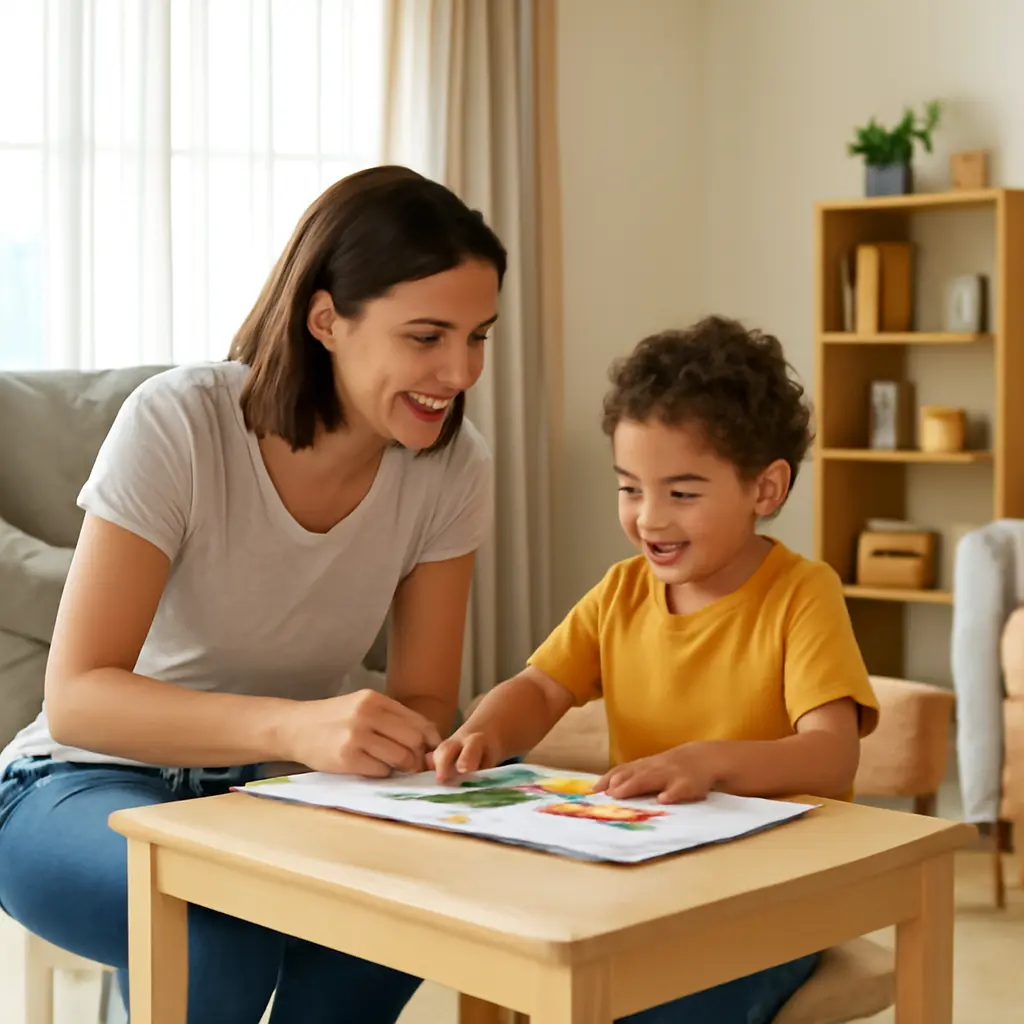
Why Responsive Back and Forth Talk Outperforms Flashcards for Early Language Growth
Responsive back-and-forth talk—often called conversational turn-taking—is an exchange in which…